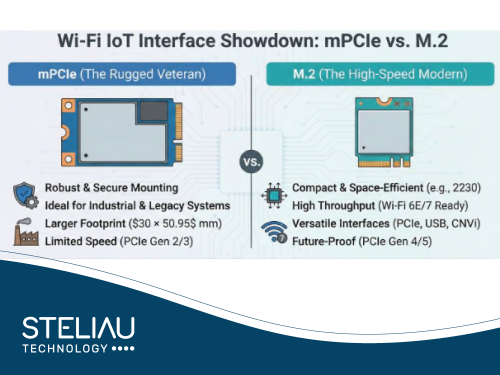
Choosing the right interface for Wi-Fi IoT modules is a classic "it depends" scenario that can make or break a hardware design. If you are weighing mPCIe against M.2 (NGFF), here is a quick breakdown of how they stack up in today's industrial and IoT landscape.
The Old Guard: mPCIe (mini-PCI Express)
While it is an older standard, mPCIe remains a powerhouse in industrial computing and ruggedized IoT gateways.
Robustness: The screw-down mounting mechanism is highly vibration-resistant, making it a go-to for automotive or factory-floor applications.
Legacy Support: If you are working with older industrial motherboards, mPCIe is likely your only native option.
Form Factor: Larger than M.2, which allows for better heat dissipation in high-power Wi-Fi modules.
The Modern Standard: M.2 (Next Generation Form Factor)
M.2 was designed to solve the limitations of mPCIe, offering more flexibility in a smaller footprint.
Space Efficiency: M.2 modules (specifically the 2230 size for Wi-Fi) are significantly smaller and thinner than mPCIe.
Higher Throughput: M.2 supports more lanes and newer standards like PCIe 4.0/5.0, which is crucial for Wi-Fi 6E and Wi-Fi 7 modules requiring massive bandwidth.
Versatility: With different "keys" (A, E, or A+E for Wi-Fi), M.2 can carry PCIe, USB, and even UART signals simultaneously.
The Verdict
Choose mPCIe if you are designing for a rugged environment where physical durability and compatibility with older industrial ecosystems are the top priorities.
Choose M.2 for almost everything else—especially if you are aiming for 6 GHz band support (Wi-Fi 6E/7), where the modern bus speeds of M.2 are strictly necessary to prevent bottlenecks.
Are you still seeing a lot of mPCIe in your new designs, or has the shift to M.2 been absolute in your sector?
Contact us.